Thursday, April 7, 2011

Science Fair!!!!

Grade 2 will have a science fair on Thursday April 28th, 20ll, 9:30-10:30 am.


April 2011


Welcome to  the Grade 2 UNIS Hanoi blog!

Zoom Zoom and a way we went, like a rocket ship.  The Transport unit of iquiry (UOI) was fantastic we learned so much about how things change over time, like different modes of transportation. Did you know the first bicycle was called a hobby horse?  It didn't even have pedals!

We began with a transptort expo. We saw many different types of transportation, we even were able to test drive a variety of vehicles. We learned that there are so many ways people are able to get from place to place. From the expo we began our learning journey.
Find out where we went and what we did.....


LITERACY


In literacy we read books  that informed us about transportation. While reading we identfied the keywords and then we crafted our own sentences using those keywords. Then we organized our writing and crreated reports about a  form of transport we chose.   Through out UOI we were able to learn how to write  important parts of a report and we became experts on the transport we chose.


MATH
In math we continued  to practice addition with regrouping.  We learned how to subtract, by making and solving subtraction word problems. We took class surveys and used the data to make graphs.  

Check out what we did!

2DL
Jun Sik Wrote a detailed conclusion about what he learned.
page1
page 2

page 3

Take a look at Yana's conlcusion.


Read what Oscar learned about Viking ships.
In 2 KD the students worked on writing their reports.

Bao Chau and Savio are looking for keywords to help write their report.
Raihan, Alex and Gia Linh are researching the mode of transportation they chose for their reports. 

Basil and Raihan are using De Bono's 6 Hats to help write their reports

 Read some pages from their reports.

 Raihan here
Bao Chau here

See what some of the kids in 2LN have been up to.

Read Shen Ern's SLC reflection here

Thao and Zoe researched information about boats, she identified key words and put them in their own words. Read how they explained how transport has changed over time. 

Read a part of Zoe's transport report here   


Click here to read what Thao wrote about transport.


See what Yuki did in math.  Yuki showed how well he can subtract and check His answer in this math assessment. Click here!

  2NW
Let's what 2NW have been working on.

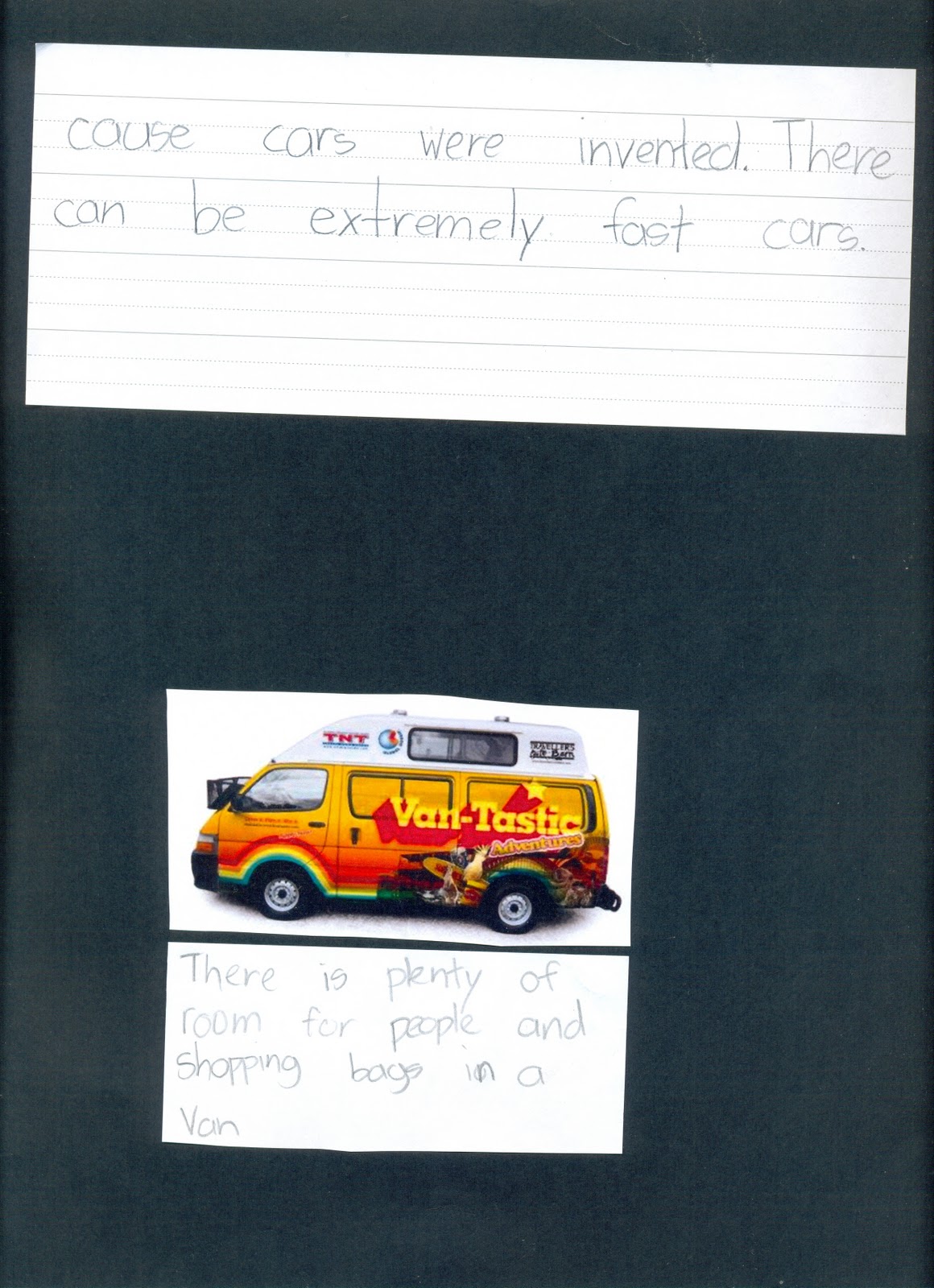
Have a look at Kalinda's diagram of a bicycle.

Read what Julian and Joaquine said about the PAC! 2NW used De Bono's 6 thinking hats to write their refelctions about the PAC.


Joaquin's PAC Reflection

Julianne's PAC Reflection


Here are excerpts from Cooper and Jacobs reports.

Cooper's diagram of a surf board and a jet ski.

Jacob's definition of a boat.
Marius
Friday April 8th is Marius' last day of school.
 We all wish you the best of luck in your new school and we will miss you very much.

Last but certainily not least!

Grade 2 EAL!

We worked hard on creating a reports in power point.  Using power point helped us to write and remember the important parts of a  report.  We also practiced writing sentences using keywords from the books we read about our transport. We also learned how to construct  sentences using adjectives, nouns and verbs the right way.

Take a look at our power point presentations.
Have look at Ji Yun's report. Click here.

Have look here at Alexander's report.

See what  Su Hyun wrote about bikes here.

Read what Bo learned about airplanes here


Up Next is "What's the Matter?"


Outcome Statements for "What's the Matter?"Unit of Inquiry


Title: What’s the Matter!


Transdisciplinary theme: How the world works.


Central Idea

Matter exists in many forms and can be changed

What key questions will drive these inquiries?


• What is matter?

• In what forms do we find matter?

• What are the properties of matter?

• Why does matter change?


Lines of Inquiry

• What is matter

• What forms can matter exist in

• How matter can be changed


Mathematics


1. Number Fractions


Outcomes


• Use manipulatives to model and compare fractions

• Represent fractions using fractional notation: halves, thirds, quarters, fifths

• Understand and model the concept of equivalence to 1: two halves=1, three thirds=1, five fifths=1


2. Introduction of multiplication and division


• Explore multiplication and division using “ groups of” and “ sharing”


• Model with manipulatives multiplication and division


• Understand the relationship between multiplication and division


• Know their facts for 2, 5 and 10‟s multiplication tables


• Understand and use number patterns to solve problems


Language


Reading and writing narratives and the scientific process


Major teaching emphasis


Reading


• Discuss how and why facts, characters, people or events are presented in a particular way by the author and illustrator

• Discuss how texts are written for different purposes and audiences.

• Model self reflection of strategies used in reading and encourage students to do the same.

• Teach the use of conventions of print


Writing


USE OF TEXTS

• Continue to expose students to a range of text forms, and discuss the features of each.

• Foster students’ sense of ‘personal voice’ and individual writing style.


CONTEXTUAL UNDERSTANDING

• Discuss the purposes and audience of a range of text forms.

• Continue to discuss some of the decisions writers make when composing texts, and provide opportunities for students to do the same.

• Encourage students to make choices about how to represent characters and events when composing literary texts.


CONVENTIONS

• Provide opportunities for students to develop, refine and use new vocabulary

• Continue to teach the use of punctuation, e.g. commas.

• Continue to build knowledge of different text forms, emphasizing:

- purpose, e.g. reports describe

- text structure, e.g. reports list details

- text organization, e.g. reports use headings

- language features, e.g. reports use present tense.


PROCESSES & STRATEGIES

• Teach students to plan for writing in a variety of ways, e.g. brainstorming, classifying.

• Teach students how to use proofreading and editing to refine their writing.

• Continue to model a variety of publishing alternatives, highlighting purposes and audience.


Monday, February 14, 2011

February 2011

 Welcome to UNIS Hanoi Grade 2 Blog! 


We are overflowing with knowledge from our last unit of inquiry (UOI), Home Sweet Home!
Ask us anything about habitats!

Can you name all of the habitats in the picture ?

In this (UOI) we began at Thu Le Zoo, where we observed aninmals and discussed the positives and negatives of zoos. Then we learned about many different habitats and discovered animal adaptations to their habitats. An expert in primatology visited us and talked about animal habitats. We had a guest speaker from the Tam Dao Bear Rehabilitation center speak to us about how we can help protect animal habitats. Finally we uncovered the human impact on animal habitats and what we can do to help. Check out our learning experiences below!

Here are some of the animals we saw at Thu Le Zoo.


Mr Tuan from The Tam Dao Rehabilitation Center


Literacy
                                           
In the  Home Sweet Home UOI we created a learning journal which show cased our learning journey through this unit. We learned how to skim and scan non-fiction text for important information, which helped us make important connections through out the unit, and we wrote some poetry.   Each class has posted excerpts from the learning journal, you will find them posted below.

 Math
In math we learned to measure everything!
From the length of our arms to how many meters/metres it is from 2KD to the elementary school office! We weighed objects, we measured capacity with sand water and even beans!  Also, we wrote, read and solved math story problems.

Lets have a look at what we did in our classes.....

2LN


Home Sweet Home


We just finished our unit of inquiry Home Sweet Home. We did loads of activities like the adaptation activity. We made a great journal book with lots of information in it. I was researching lots of information on civet cats and what they eat. We visited a zoo called Thu Le Zoo but some of the cages were too small and none of them had any grass on the bottom of the cages. We researched in books and on the computers. I really loved this unit but I guess its time to move to another unit of inquiry.


written by Grace


We explored many different habitats and the animals and plants that depend on them.


We learned about the different ways habitats are  destroyed.

We learned about animal adaptation by creating mind maps.

We wrote poetry.  
Ode to a kakapo.                                          
written by Zoe.
Solve this riddle.
Guess what animal this is!
A riddle written by Chuc An
 Decision Trees


Posters for awareness.


Let's see what  2 KD have been up to.
They wrote poetry about different animals.


Alexander wrote an acrostic poem.
Tat Anh wrote a quatrain about sharks.
               An acrostic written by Bao Chau


A cinquain written by Zihan.
To see Josephine's mind map click here.


Let's see what 2NW have done!
Read what Julianne thinks about protecting habitats.


 Read Zoe's reflection on Home Sweet Home.


Can you guess the riddle written by Marius?

Nozomu pleads for us to protect pandas!


Take a look at 2DL.


Home Sweet Home


During Home Sweet Home unit I learnt about causation and animals feelings. I know we should not cut down trees and my favourite part of the unit was playing fun games. Playing games showed me how animals live, how some animals are happy and some are sad. It made me wondering what will happen to the animals that are endangered. When we were almost done with our unit we made posters about how to save the environment and endangered animals. Then we learnt what might happen to the habitats if we keep cutting trees and destroying habitats. There might be no desert left. I think I could learn a lot more in Home Sweet Home unit.


written by Matthew


Read an exposition.


Zoos are Bad and Good


Last week we studied a zoo (I could not go) in Hanoi. We found out good and bad things about zoos.


Zoos are bad because animals are in very small cages and people don’t clean them. People feed animals people food. Animals are treated badly.


Zoos are good because hurt animals can get treated if they go to a special zoo. Animals can have big cages in some places.


Zoos are good because in Washington there are lots of zoos which feed animals their right food and you can learn about animals and you can see the animals. Zoos are good and bad because you can learn about animals but some animals are treated badly.


By Fiona – Grade 2DL


Riddles written by students in 2DL.
Can you guess the animal?

written by Duc Anh.


written by Travis


Read what Valarie wrote about protecting habitats here.


  EAL
We have been learning how to skim and scan for information about an animal we wanted to learn more about. The information we gathered was put together into photostory.
 Our research began with questions and some facts we knew about animals. We used voice thread to share our questions and discuss what we knew.
note: the voice recorder didn't work at the time so the EAL students typed what they wanted to say. Grammar was not the focus, so there will be some mistakes at this early stage in our unit.
click on the hyperlink to see what we said.
Zoo Animal Commentary

We learned about the parts of speech, i.e. nouns, ajectives and verbs.

Our class will continue to work on informational text by reading, writing and discussing many different kinds of reports. We will practice using and identifying parts of speech when we speak, read and write.


Here is a photostory created by Bo Collet


We also experimented with poetry!

Golf
Huge, great
Move, drive, hit
Golf is very excited
nine holes
Cinquaine by Su Hyun Kim.


What's Next!


GO...


Unit of Inquiry


Title: Go


Transdisciplinary theme: How we organize ourselves


Central Idea


Over time transport has been developed to move people and goods from one place to another.


Focusing on the outcomes and skill development above, what key questions will drive these inquiries?


• What is transport and how do we use it?


• How has transport changed over time?


• What effect has transport had on our society and our environment?


Lines of Inquiry


• The forms of transport   


• How people and goods move from one place to another


• How transportation has changed over time


• The effect transport has on a society and the environment


Mathematics


Data Handling


• Carroll Diagrams


• Venn Diagrams


• Graphs – Picture and bar.


Outcomes


• Discuss, compare and create sets from data using Tree, Carroll, Venn and other diagrams
• Use, process and interpret the data of a teccher generated survey
• Collect and display data in a bar graph and interpret results
• Use the scale on the vertical axis of a bar graph to represent 2, 5, or 10 units
• Understand that a database can be used to answer questions and solve problems


Continue Focus on Addition and Subtraction


• Automatically recall basic addition and subtraction facts to 20


• Model and estimate addition and subtraction equations to 100, with and without regrouping


• Use and describe multiple strategies to solve addition and subtraction problems


Language


Reading and writing informational text


Major teaching emphasis


Reading


Use of texts


• Read and reread a variety of texts, both literary and informational, providing opportunities for students to do the same.


• Teach students to draw upon explicit info by sequencing events.


Processes and Strategies


• Consolidate known comprehension strategies and teach additional strategies, e.g. skimming and scanning.


Environment and attitudes


Encourage students to select their own reading materials according to purpose.


Writing


Use Of texts


• Continue to expose students to a range of text forms and discuss features of each


• Provide opportunities for students to compose a range of text forms and discuss features of each


Contextual understanding


• Model and encourage the use of devices and discuss how they influence meaning.


Conventions


• Continue to build knowledge of different text forms, emphasizing purpose, text structure, text organization, language features.